Monday, September 30, 2013

LEAD POISONING PLUMBISM


  • Pica
    • Defined as persistent eating of non-nutritive material for 1 month or more
    • Always search for lead lines in any child with an ingested foreign body
  • Main source of lead intoxication is lead paint used in houses painted before 1980
  • Absorption is greater in children than adults
    • Lead may be inhaled as well as ingested
      • Symptoms develop more quickly through GI tract
      • Toxicity more severe with co-existing iron, zinc, or calcium deficiency
  • Pathology
    • Lead concentrates in metaphyses of growing bones
      • Distal femur
      • Both ends of tibia
      • Distal radius leading to
        • Failure of removal of calcified cartilaginous trabeculae in provisional zone
  • Clinical findings
    • Neurological
      • Learning disability
      • Decreased IQ
      • Mental retardation
      • Encephalopathy
      • Motor deficits
      • Seizures
      • Cerebral edema
      • Hearing loss
    • Gastrointestinal
      • Abdominal pain
      • Nausea
      • Vomiting
      • Diarrhea
      • Constipation
      • Anorexia
      • Metallic taste in mouth
      • Ileus
    • Renal
      • Tubular damage
        • Azotemia
      • Gout
    • Hematologic
      • Affects blood synthesis
      • Hemolysis
      • RBC stippling
      • Iron deficiency
    • Musculoskeletal
      • Muscle and joint pain
    • Soft tissue
      • Blue-black line in gum margins
    • Endocrine
      • Decreased stature
        • Decreased growth hormone
      • Decreased vitamin D levels
  • Laboratory findings
  • Imaging findings
    • Cerebral edema in acute lead intoxication
    • Particles of lead in GI tract
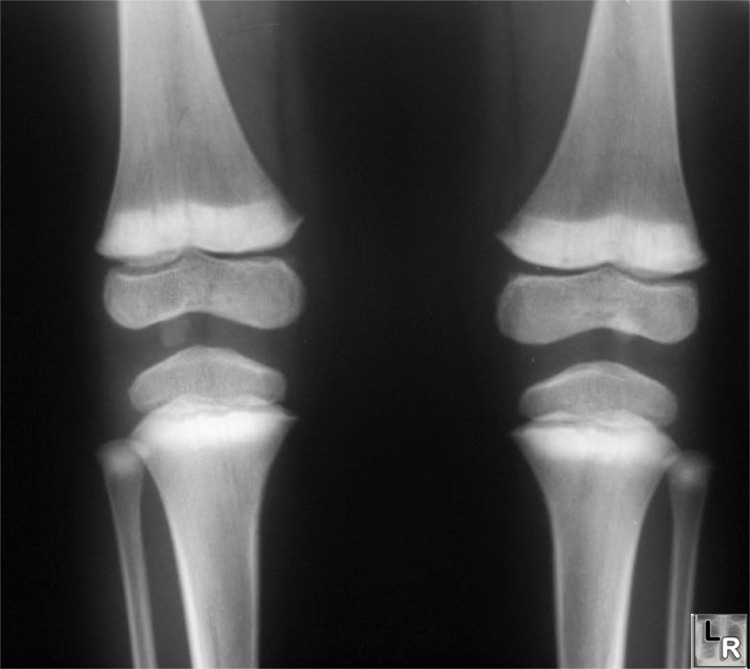
    • Bands of increased density at metaphyses of tubular bones (growing bone)
      • Metaphyses of growing bones may be dense normally
        • Lead lines more apt to be seen in proximal fibula and distal ulna where growth is not as great as other long bones
      • Lead lines may persist


Frontal radiograph of both knees of a child with lead poisoning show dense metaphyseal bands
involving not only distal femurs and proximal tibias but proximal fibulas as well

  • Bone-in-bone appearance
  • Abnormalities in bone modeling
    • Erlenmeyer flask appearance to distal femur

  • DDx (see tables below)
  • Treatment
    • Surgical removal of lead foreign bodies in the gut (e.g. dice containing lead) if not eliminated within 2 weeks
    • Chelation is indicated if the level is greater than 45 mcg/dL even if asymptomatic
      • First correct iron deficiency
    • Chelating agents include EDTA, BAL, D-Penicillamine, and Succimer

Lucent Metaphyseal Bands
Normal
Leukemia
Neuroblastoma
TORCH infection
Dense Metaphyseal Bands
Normal
Lead poisoning
Treated leukemia
Healing rickets

Tuesday, September 24, 2013

SUPPORT YOUR HEART


“If you exercise regularly, eat right and don’t smoke, you are on your way to healthier heart”, says Dr. Willet.

Taking a few healthy lifestyle steps can help you feel better and reduce your risk of heart attack and stroke. Here, what you need to know to eat right, get active and quit smoking.

To put the pieces of an ideal heart-healthy eating plan together, “think of diet and nutrition like an orchestra- all components should be balanced for optimal heart health”, says Walter Willett, MD chair of the nutrition department at the Harvard School of Public Health.

EAT FOR YOUR HEART:

To get started, try these six simple steps:

Ø Control your portion size

Fill half a normal dinner plate with green leafy, bright or deeply colored vegetables such as spinach and beets. These veggies are packed with heart-healthy nutrients. Leave a quarter each for lean protein and complex carbohydrates, such as potatoes (no fried), brown rice and whole wheat pasta.

Ø Eat less red meat

It’s high in saturated fat, which boosts cholesterol levels. Instead, choose proteins such as broiled or grilled fish, skinless poultry and beans. Consider eating one meat-free meal a day.

Ø Choose nonfat and low-fat dairy

Opt for skim or soy milk, fat-free yogurt and low fat cheese. Dairy is rich in potassium, which reduce stroke risk, according to recent research.

Ø Fill up on fruits and vegetables

The American Heart Association (AHA) recommends you get at least four to five cups of fruit and the same amount of vegetable daily. One cup is about of woman’s fist.

Ø Favor fiber-filled foods

Fiber-rich foods such as produce and whole grains are satiating- so you may feel fuller longer. Soluble fiber, found in beans, peas, oats, apples, citrus, barley and psyllium, can help lower cholesterol.

Ø Toss the salt shaker

Salt causes fluid retention, which raises blood pressure and can worsen angina. Follow the AHA recommendation of less than 1500 mg a day, unless your doctor suggest otherwise. To reduce salt in your diet, eat more fresh food and fewer processed products, which tend to be loaded with sodium. If you’re out at a restaurant, ask if the chef can prepare low salt versions of menu items for you.


          GET MOVING:

          Exercise will help make you stronger and increase what’s known as exercise tolerance, how much you can physically exert yourself before becoming exhausted. The better your exercise tolerance becomes, the harder you can work out without experiencing angina pain. Exercise also helps lower blood pressure, cholesterol and blood glucose levels.

Ø Enlist a buddy

Plan to exercise with your spouse, a family member or friends to help you stay committed.

Ø Start slow and build up

“You don’t have to work out like an Olympic athlete”, says Robert Eckel, MD, head of preventive cardiology at the University of Colorado Anschutz Medical Campus in Aurora.

How much exercise is enough to help your heart?

Thirty minutes a day, at least five days a week, of brisk walking is fairly standard. However, if you heart’s sake, your doctor may want you to strive for an hour of physical activity daily. You can break it up into 15 minute chunks.

Ø Log it

Keep track of the time, speed and duration of you walks.


          KICK BUTTS

          Quitting is essential for anyone who smokes, but it’s especially important for people with angina.
            Smoking causes your arteries to constrict, which can make angina worse. Talk to your doctor about tools for quitting. Research shows that combining support and medical therapy is most effective.


Get helpful tips and information….at www.SpeakFromTheHeart.com


Thursday, September 19, 2013

NEW TEST RAPIDLY DISTINGUISHES VIRAL FORM BACTERIAL INFECTIONS

A new test that analyzes patients' immune responses, rather than the pathogens themselves, can rapidly distinguish viral infections from bacterial infections, according to an article published in the September 18 issue of Science Translational Medicine.
If carried into clinical use after further evaluation, the assay could help physicians better decide which patients need antibiotics and avoid inappropriate prescribing of antibiotics to patients who will not benefit.
Aimee K. Zaas, MD, MHS, associate professor of medicine at the Duke Institute for Genome Sciences and Policy, Durham, North Carolina, and colleagues previously reported that they could classify individuals according to respiratory viral infections based on microarray profiles of blood samples — work that has been reproduced by other researchers.
In the current study, the researchers used a Taqman low-density array (TLDA) platform to develop a reverse transcription–polymerase chain reaction (RT-PCR) assay and a predictive algorithm to test the blood of patients presenting with infection symptoms.
To develop the assay, they first tested 17 healthy volunteers who had been inoculated with influenza H3N2/Wisconsin and 24 who had been inoculated with influenza H1N1/Brisbane. They found that using expression data from a relatively small number of genes, they could classify the volunteers at 100% accuracy for H3N2 and 87% accuracy for H1N1.
"The performance of the RT-PCR assay to identify symptomatic versus asymptomatic individuals with experimentally inoculated influenza H1N1 or H3N2 is excellent...with cross-validation highly accurate between influenza subtypes," the researchers write.
They then validated the assay by testing peripheral blood RNA from 102 patients presenting with respiratory infections at Duke University Medical Center; Henry Ford Medical Center in Detroit, Michigan; or Monash General Hospital in Melbourne, Australia. The patients had either microbiologically proven viral respiratory infection or systemic bacterial infection. In this population, sensitivity of the RT-PCR assay was 89% (95% confidence interval [CI], 72% - 98%), and specificity was 94% (95% CI, 86% - 99%).
Ruling in or out
"[T]he viral infection 'score' represents a measure with potential clinical benefit for both 'ruling in' and 'ruling out' viral respiratory infection...with possibilities for improved triage, decreased utilization of inappropriate antibacterial therapy, and guiding judicious use of limited antiviral resources in a pandemic setting," the researchers write.
"It's an approach that could turn out to be very useful clinically, and certainly is likely to help us understand viral infections and how they differ from bacterial infections better," Andrew T. Pavia, MD, chief of the Division of Pediatric Infectious Diseases, University of Utah Health Sciences, Salt Lake City, and an infectious diseases advisor to the Infectious Diseases Society of America, told Medscape Medical News.
"What they've done is to turn the approach to diagnosing viral or bacterial infection around on its head," he continued. "We normally use tests to detect the germ or the pathogen that we're interested in. What they've done is to try and use the pattern of the human response to the infection to tell whether it's a bacteria or a virus. Obviously, that's terribly important, because if we can accurately detect who has a virus, we can avoid excessive antibiotic use and restrict antibiotic use to those people who have a bacterial infection."
Dr. Pavia explained that at this time, even with the most sophisticated devices available, physicians can only detect about 16 different viruses of approximately 30 or 40 that might be causing an illness. "The potential for a test like this, turned into a device, is perhaps it could be cheaper and more efficient. It wouldn't tell you, 'you have influenza B or you have corona virus HKU,' but it could tell you, 'you don't have a bacterial infection and we can spare you the antibiotic exposure.' "
Information from Industry
Early treatment of AFib may stem disease progression

Drs Ellenbogen, Chung, and Calkins discuss the impact of early treatment on disease progression.

View video
In their analysis, the researchers conclude, "[W]e have established a 'proof of concept' that host expression of a relatively small set of genes, as measured by RT-PCR from blood RNA, can be used to classify viral respiratory illness in unselected individuals presenting at an emergency department for evaluation of fever."
"What they've done is pretty efficient," Dr. Pavia said. "But I think there's a lot more confirmatory work that needs to be done. You now have to take this into a more real-world setting looking at a variety of children and adults and prove that it works on other people. You would have to take what they've done, using the RT-PCR TLDA card, not suitable outside a research lab, and develop a convenient device. It's all doable."
This research was supported by the by the Defense Advanced Research Projects Agency, the National Institutes of Allergy and Infectious Diseases, and the Clinical Science Research and Development Service of the Veterans Health Administration. Six authors report filing for a provisional patent on the respiratory viral response signature. Four authors report receiving funding from Novartis. The other authors have disclosed no relevant financial relationships.
Sci Transl Med. 2013;5:203ra126. Abstract

http://www.medscape.com/viewarticle/811219

FISH OIL MAY PROTECTED AGAINST ALCOHOL-RELATED DEMENTIA

Exposure to a compound found in fish oil may protect against the development of dementia in heavy drinkers, new research suggests.
A study presented at the recent Congress of the European Society for Biomedical Research on Alcohol in Warsaw, Poland, examined rat brain cells exposed to alcohol levels equivalent to 4 times the legal driving limit.
Results showed that the cell cultures that were also exposed to omega-3 docosahexanenoic acid (DHA) showed approximately 90% less neuroinflammation and 90% less neuronal brain cell death compared with the cells that were not exposed to the fish oil compound.
"We hypothesized that omega-3 fatty acids, specifically DHA (which has been shown to neuroprotect from other acquired brain insults in the laboratory and to some degree in human studies) would suppress or prevent the neuronal degeneration due to binge alcohol exposure," principal investigator Michael A. Collins, PhD, professor in the Department of Molecular Pharmacology and Therapeutics at the Stritch School of Medicine at Loyola University, Chicago, Illinois, told Medscape Medical News.
"And basically, that is what we found," he added.

Relevant to Humans
                   
Dr. Collins noted that although this was an animal study designed to measure neurodegeneration and related phenomena, and not a study specifically of dementia, "since brain degeneration underlies persistent or permanent dementia, the results were extrapolated to what might happen in humans."
And although he noted in a release that further studies are now needed, "fish oil has the potential of helping preserve brain integrity in abusers. At the very least, it wouldn't hurt them."
In 2011, Dr. Collins and colleagues published a meta-analysis of 143 studies showing that consuming up to 2 alcoholic drinks a day for men and 1 drink a day for women appeared to reduce the risk for dementia and cognitive impairment.
However, "too much alcohol overwhelms the cells," they noted in a release.
"Our previous work and that of others had linked neurodegeneration to 'neuroinflammatory'-like mechanisms that include oxidative stress (oxygen and nitrogen free radicals). The oxidative stress, we suspected, resulted in part from alcohol-induced excessive release of unsaturated fatty acids from brain membranes," explained Dr. Collins.
In the current study, the researchers exposed brain cell cultures from adult rats to heavy amounts of alcohol and then compared half the cells, which were further exposed to omega-3 DHA, with the other nonexposed half.
"Our results indicate excessive arachidonic acid (AA) mobilization due to increased phospholipase A2 (PLA2) levels/activity, and this appears related to elevations in astroglial aquaporin-4 (AQP4) and brain edema," write the investigators.
In other words, excessive drinking can cause higher levels of PLA2 activity, leading to excessive production of AA (a polyunsaturated omega-6 fatty acid), which in turn leads to increased AQP4/neuroinflammation and swelling of the brain.
However, inhibiting AQP4 was found to be neuroprotective to the cells.

Best Protection
Sponsored

Gestational Diabetes: Caring for women during and after pregnancy
Summary of clinical evidence about prenatal treatment and delivery management for women with gestational diabetes. Follow-up care is also covered.
Adding omega-3 DHA to the cell cultures not only significantly decreased the release of AA and the elevated levels of PLA2 and AQP4 but also decreased ADP-ribose polymerase-1 (PARP1) elevations and overall neurodamage.
Dr. Collins reported that the investigators are planning now to conduct studies that replicate the findings in intact adult rats exposed to binge-drinking levels of alcohol and that elucidate how DHA exerts its protection in the brain.
However, he stressed that helping heavy drinkers to cut back the amounts they consume or to quit altogether is the best way to protect their brains.
"We don't want people to think it's okay to take a few fish oil capsules and then continue to go on abusing alcohol," he said.

The study was supported by the Loyola University Alcohol Research Program and a grant from the United States Public Health Service.
The 14th Congress of the European Society for Biomedical Research on Alcoholism. Abstract 01.2, presented September 8, 2013.

http://www.medscape.com/viewarticle/811196

Tuesday, September 10, 2013

Early 'Junk Food' Exposure Risks Kids' Mental Health

Along with the myriad negative effects on physical health, "junk food" during pregnancy and in early childhood is linked to a significantly increased risk for poor mental health, including anxiety and depression, in very young children, new research shows.
A large, prospective study by investigators at Deakin University in Melbourne, Australia, showed that higher intakes of unhealthy food by mothers during pregnancy were linked to higher levels of behavioral and emotional problems in children. Both an increased intake of unhealthy food and, independently, reduced consumption of healthy, nutrient-dense food by children during the first years of life were also linked to increased levels of these problems.
"This study comes from the largest cohort study in the world and is the first to suggest that poor diet in both pregnant women and their children is a risk factor for children's mental health problems," principal investigator Felice Jacka, PhD, told Medscape Medical News in an email.
The study was published online August 17 in the Journal of the American Academy of Child and Adolescent Psychiatry.
Food and Mood Link
Several studies by Dr. Jacka and colleagues, as well as other research groups, have demonstrated a clear link between mood and food. One of Dr. Jacka's most recent studies, published in September 2011 in PLoS One and reported by Medscape Medical News at that time, showed that diet quality has a significant effect on mental health outcomes and may play a role in the prevention and treatment of common psychiatric disorders such as depression and anxiety in teens.
Other studies have shown similar associations between diet quality and mental health in adults. However, the researchers point out that the impact of maternal and early postnatal nutritional exposures on children's subsequent mental health has not been explored before now.
The current study included 23,020 women and their children who were participants in the Norwegian Mother and Child Cohort Study (MoBa). Data were derived from self-report questionnaires sent to mothers at 17 weeks' pregnancy and in later pregnancy and at intervals after birth when children were aged 6 months, 1.5 years, 3 years, and 5 years.
A 225-item food frequency questionnaire (FFQ) developed specifically to assess maternal diet in the study was employed. It is designed to capture dietary habits and intake of dietary supplements during the first 4 to 5 months of pregnancy.
 
 
On the basis of these data, women received scores on each of 2 major dietary patterns — a "healthy" pattern, characterized by high intake of vegetables, fruit, high-fiber cereals, and vegetable oils, and an "unhealthy" pattern, characterized by a high intake of processed meat products, refined cereals, sweet drinks, and salty snacks. These scores were independent of each other.
The children's diet was assessed using a 36-item FFQ comprising dietary items on types of foods and drinks such as dairy products, cereal-based porridge, and fruit juice. Healthy and unhealthy dietary pattern scores were also determined for children.
The researchers used a short form of the Child Behavior Checklist to assess internalizing problems, including anxiety and depression, and externalizing behaviors, capturing symptoms of attention-deficit/hyperactivity disorder, oppositional defiant disorder, and conduct disorder.
Novel Data
The researchers found that women who ate more unhealthy foods than the average were significantly more likely to have children with more behavioral problems, such as tantrums and aggression.
The results also showed that children who ate more unhealthy foods in early life or who did not eat sufficient amounts of nutrient-rich foods during the first years of life exhibited more of these "externalizing" behaviors as well as increased "internalizing" behaviors, indicative of depression and anxiety.
"In this study, we report highly novel data suggesting that maternal and early postnatal dietary factors play a role in the subsequent risk for behavioral and emotional problems in children.
Sponsored
A systematic review of 166 clinical studies will help inform discussions of options with patients and assist in decisionmaking.
"Both an increased intake of unhealthy foods and a decreased intake of nutrient-rich foods in early childhood were independently related to higher internalizing and externalizing behaviors in young children. These behaviors are established early markers for later mental health problems," the researchers write.
"We've known for some time that very early life nutrition, including the nutrition received while the child is in utero, is related to physical health outcomes in children — their risk for later heart disease or diabetes, for example. But this is the first study indicating that diet may also be important to mental health outcomes in children," Dr. Jacka said in a statement.
Dr. Jacka also noted that the average age of onset for anxiety disorders is only 6 years; for depression, it is 13 years. As such, she said, these findings have "profound" public health implications, particularly with respect to the fast-food industry.

The study was funded by the Brain and Behavior Research Foundation. The authors report no relevant financial relationships.
J Am Acad Child Adolesc Psychiatry. Published online August 17, 2013.